



Quick summary
- For the ancient Egyptians, death was not an end but a gateway to a perilous journey.
- To navigate the gates of the underworld and face the judgment of the gods, the deceased relied on a collection of sacred spells known as the Book o…
NavigationIn this article
Death was not, in the eyes of the ancient Egyptian, the end of the story.
It was more like a door.
A door that closes on the world of the living, but opens on the other side to an unknown journey, filled with gates, guards, trials, gods, and terrifying creatures.
To survive this journey, the Egyptians believed the deceased needed knowledge.
They needed to know the right words, the names of the guards, the path to take, how to defend themselves, and most importantly: how to prove they were worthy of another life after death.
From this belief emerged what we call today the "Egyptian Book of the Dead."
However, the name can be misleading.
The Book of the Dead was not a single book with a fixed version or a known author, but rather a collection of spells, texts, and funerary prayers intended to assist the deceased on their journey to the afterlife. Some were written on papyrus scrolls and placed with the deceased inside the tomb, while similar funerary texts appeared on coffins and tomb walls. The British Museum notes that the term "Book of the Dead" itself is a modern designation for this collection of texts, not the name used by the ancient Egyptians themselves.
Among the names researchers use to translate the title of these texts is: "The Book of Coming Forth by Day" or "The Book of Emerging into the Day," a title that carries a completely different meaning from the grim image suggested by the name "Book of the Dead."
The core idea was not to glorify death, but to search for a way back to light and life.
What Happens After a Person Dies?
According to ancient Egyptian beliefs, a human was not merely a body that ended with death.
Their identity consisted of multiple elements, including the physical body, the "Ka" (associated with vital force), and the "Ba" (associated with the individual's personality and their ability to move between worlds), in addition to the name, the heart, and other spiritual elements.
This is why preserving the body was a vital part of funerary rituals.
If the body decomposed or was destroyed, there was a fear that these elements would lose the point of connection that allowed for the continued existence of the person in the afterlife.
Egyptian sources describe the journey of the deceased through a world known as the "Duat," the realm of the afterlife that the soul had to cross before reaching its final destiny. British Museum materials indicate that the Egyptians envisioned this journey as long and difficult, ending for the successful by reaching an ideal place called the "Field of Reeds."
But arrival was not guaranteed.
A Journey Through a World Full of Dangers
In the Duat, the path was not open.
There were gates.
And every gate had a guardian.
In some texts, the deceased had to know the name of the gate, the name of the guardian, and the specific words to say to be allowed passage.
A mistake could mean failure.
For this reason, the texts of the Book of the Dead included spells believed to protect the deceased from snakes, crocodiles, and hostile creatures, helping them cross the gates and face the forces that obstructed their path.
British Museum materials mention that some spells, such as those associated with the gates, provided the deceased with the information needed to deal with the guardians during their journey.
But all those dangers were merely a prelude to the most famous test in the Egyptian funerary creed.
A test where strength did not determine the outcome.
But the heart.
The Court of the Dead
In one of the most famous depictions of the afterlife, the deceased reaches the Hall of Judgment.
There appears Osiris, the god associated with death, resurrection, and the underworld.
The deceased stands before a divine court to declare their innocence.
In Chapter 125 of the Book of the Dead, we find what is modernly known as the "Negative Confession," where the deceased declares before a group of gods that they have not committed a series of forbidden acts.
I have not killed.
I have not caused hunger.
I have not stolen.
I have not caused pain.
I have not encroached upon the rights of others.
I have not tampered with the scales.
These phrases, in various forms, were part of the deceased's declaration that they lived according to the moral and cosmic order represented by the concept of "Ma'at": truth, justice, order, and balance.
University College London texts explain that Chapter 125 includes the deceased's declaration of innocence before the court and is closely linked to the scene of the weighing of the heart before Osiris.
But words alone were not enough.
There was a scale.
Weighing the Heart Against the Feather of Ma'at
This is one of the most famous scenes that has come down to us from Ancient Egypt.
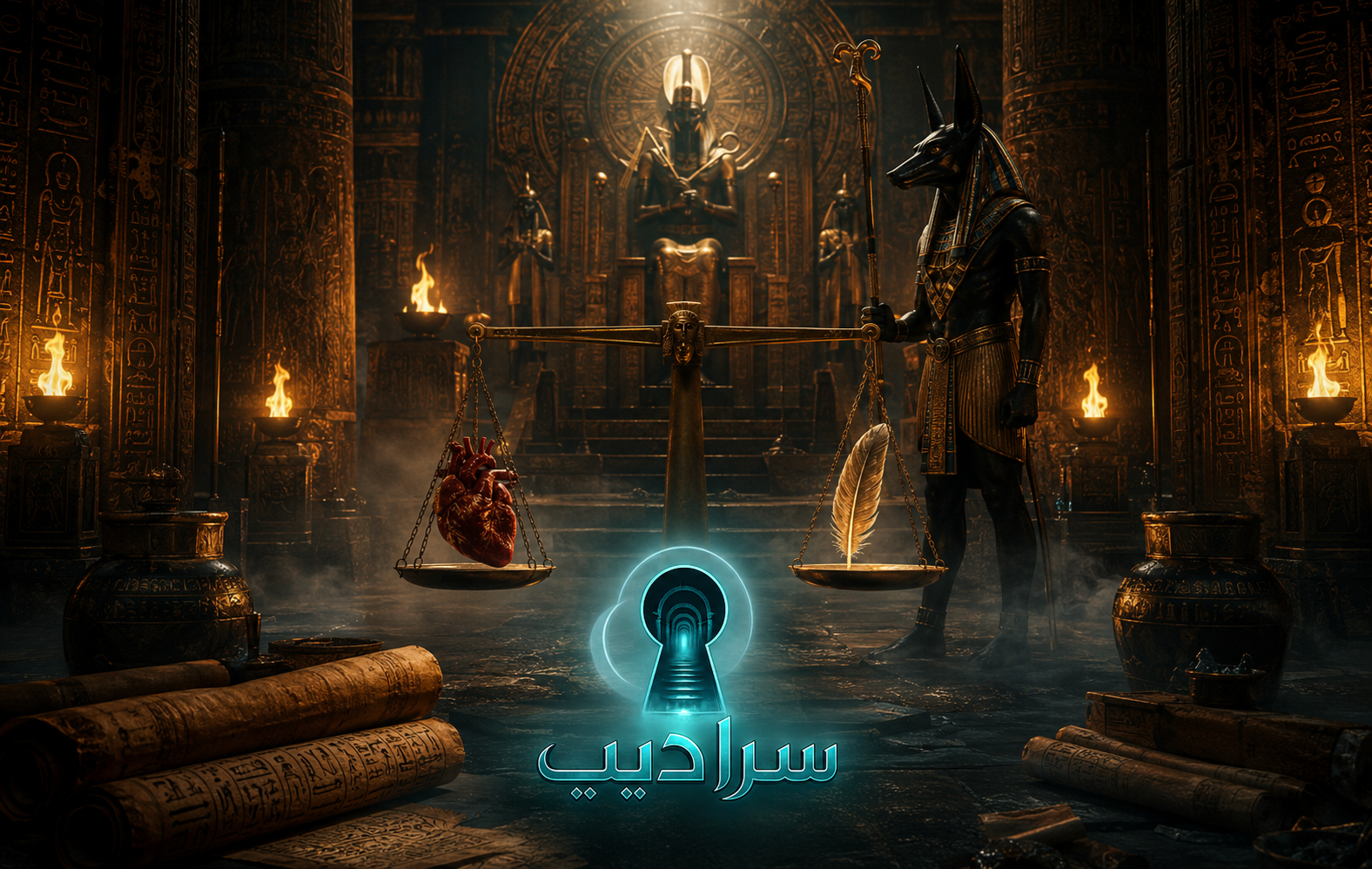
The heart of the deceased is placed on one scale pan.
On the other pan is placed a feather symbolizing "Ma'at," meaning truth, justice, and order.
The heart held exceptional importance in ancient Egyptian thought; it was linked to the personality, memory, behavior, and moral value of the human being.
Now came the moment of the test.
Did its owner live a life in harmony with Ma'at?
Or did their heart carry that which condemned them?
Scenes from the Book of the Dead show the god Anubis supervising the scales, while Thoth is associated with recording the result of the judgment, and Osiris sits in the position of the judge or the Lord of the Underworld.
The Metropolitan Museum confirms that the "Weighing of the Heart" scene was part of the ritual in which the deceased proved they lived according to the required moral order before entering eternal life.
But near the scales, a terrifying creature waited.
Its name was "Ammit."
What Happens if the Deceased Fails?
Ammit is a hybrid mythical creature, associated in Egyptian imagery with parts of dangerous animals such as the crocodile, the lion, and the hippopotamus.
Its function was terrifyingly simple.
To devour the heart of whoever fails the test.
Educational sources from the British Museum explain that those who fail the weighing of the heart do not reach the blessed life in the Field of Reeds; instead, their heart becomes prey for Ammit.
However, this did not necessarily mean the image of "Hell" as it appeared in later religious conceptions.
The greatest danger in some Egyptian conceptions was something that perhaps seemed even more terrifying to them:
Final annihilation.
That a person would be deprived of their continued existence in the afterlife.
The British Museum describes this outcome as a type of "second death," where the deceased loses the possibility of continuing their life after death.
As for those who succeed…
Another life begins for them.
The Field of Reeds: Paradise as the Egyptians Imagined It
After passing the trial, the deceased could reach what was known as the "Field of Reeds."
But the Egyptian paradise was not a completely alien world.
It was, in many depictions, an idealized version of Egypt.
Fertile fields.
Waters and canals.
Abundant crops.
Sunlight.
Meeting with gods and relatives who had died before.
A life that continues, but without many of the pains of earthly life.
The British Museum describes the Field of Reeds as an idealized version of Egypt, containing plants, rivers, and fields, where the deceased could reunite with their relatives and live in a state of peace and abundance.
But a small problem appeared even in paradise.
Work.
If the afterlife resembled Egypt, it meant there were fields that needed farming and tasks that had to be completed.
Here, a strange solution emerged.
Small statues known as "Ushabti" or "Shawabti."
They were placed in tombs, and according to funerary belief, they were supposed to perform the required tasks on behalf of the deceased when called to work in the afterlife.
Even death, it seems, was not a sufficient excuse to escape work.
Why Were the Spells Necessary?
When we look at the Book of the Dead today, it might at first glance seem like a book of ancient magic.
But for those who used it, it was closer to a survival guide.
Some texts protect the body.
Some help the deceased to breathe, drink, and eat.
Some protect them from hostile creatures.
Some provide them with the names of guardians and gates.
And some concern the heart itself.
There was a fear that a person's heart might testify against them during the trial.
For this reason, one of the famous spells, known as Spell 30B, was associated with the attempt to prevent the heart from standing against its owner at the moment of judgment.
The Egyptian did not just want their enemies to be silent.
They wanted to ensure that even their own heart would not betray them.
Did Every Egyptian Have a Book of the Dead?
No.
This is an important point.
There was no single, unified version carried by every person.
The Book of the Dead was a flexible collection of texts from which parts could be chosen according to the historical period, financial means, and social status.
Preparing a papyrus scroll decorated with texts and drawings was an expensive process.
The British Museum mentions that the wealthy and those of high status were better able to own detailed copies; in fact, some scrolls were prepared in advance with a blank space left to add the buyer's name later.
In other words, even preparation for the afterlife was influenced by wealth and status in the first world.
Were the Egyptians Obsessed with Death?
It is easy today to look at mummies, tombs, coffins, and the Book of the Dead and conclude that the ancient Egyptian lived their life in constant fear of death.
But the picture is more complex.
All this interest in death might actually be an expression of an immense attachment to life.
The Egyptian did not want to disappear.
They wanted to wake up again.
To breathe.
To eat.
To see the sun.
To be known by others by their name.
To meet their family.
And for their existence to continue forever.
That is why death, according to these beliefs, was not the end of the road.
But the most dangerous stage of it.
The Question the Book of the Dead Left Behind
After thousands of years, the scene of the scales remains one of the most thought-provoking images of Ancient Egypt.
A human stands alone.
Carrying no gold.
No army.
No position.
And unable to take what they gathered in their life with them.
Before them is a scale.
In one pan of the scale is their heart.
In the other is a feather.
Perhaps this is why the Book of the Dead remains fascinating even today.
Not because it tells us what actually happens after death; that is a matter beyond what archaeology can prove.
But because it tells us how a civilization that lived thousands of years ago tried to answer a question that humans are still asking today:
What awaits us when life ends?
And is there something on the other side?
Author: Saradeeeb Team
Have a thought or question about this article?
Continue the conversation in the community and share your ideas with readers and writers.

Comments 0
Share your thoughts respectfully. Abusive or disruptive comments may be hidden.