



Quick summary
- In the early hours of the year 2000, the city of Al-Nouran celebrated the new millennium, unaware that a dark, decades-old secret was finally comin…
NavigationIn this article
In the early hours of the year 2000, the city of Al-Nouran was celebrating the beginning of the new millennium. The streets were filled with fireworks, music blared from cafes, and the main square was crowded with hundreds of people who kept chanting the countdown until the clock struck twelve.
But on the other side of the city, specifically inside an old building on Station Street, a crime occurred that no one heard about until the celebrations were over.
At exactly twelve-seventeen, the police station received a short call from an unknown man who said in a trembling voice:
— You will find him in apartment number 2000… but do not believe the clock.
Then the line went dead.
The duty officer thought the caller was drunk or trying to play a prank, as the building in question did not actually contain an apartment with that number. Nevertheless, a patrol was sent to verify.
Detective Salim Al-Rawi arrived at the building half an hour later. He was a man in his late thirties, known for his calmness and ability to notice small details. He was met by the building's caretaker, an elderly man named Imad, who confirmed to him that the highest apartment number was 24.
But when they entered the elevator, Salim noticed a small button below the number panel, on which was written in faint black ink:
2000
He pressed the button, and the elevator moved upward even though the building did not exceed six floors. The cabin stopped after a few seconds, and the door opened onto a narrow corridor that did not appear on the building's blueprints.
At the end of the corridor was a single door.
On it was a metal plate bearing the number: 2000.
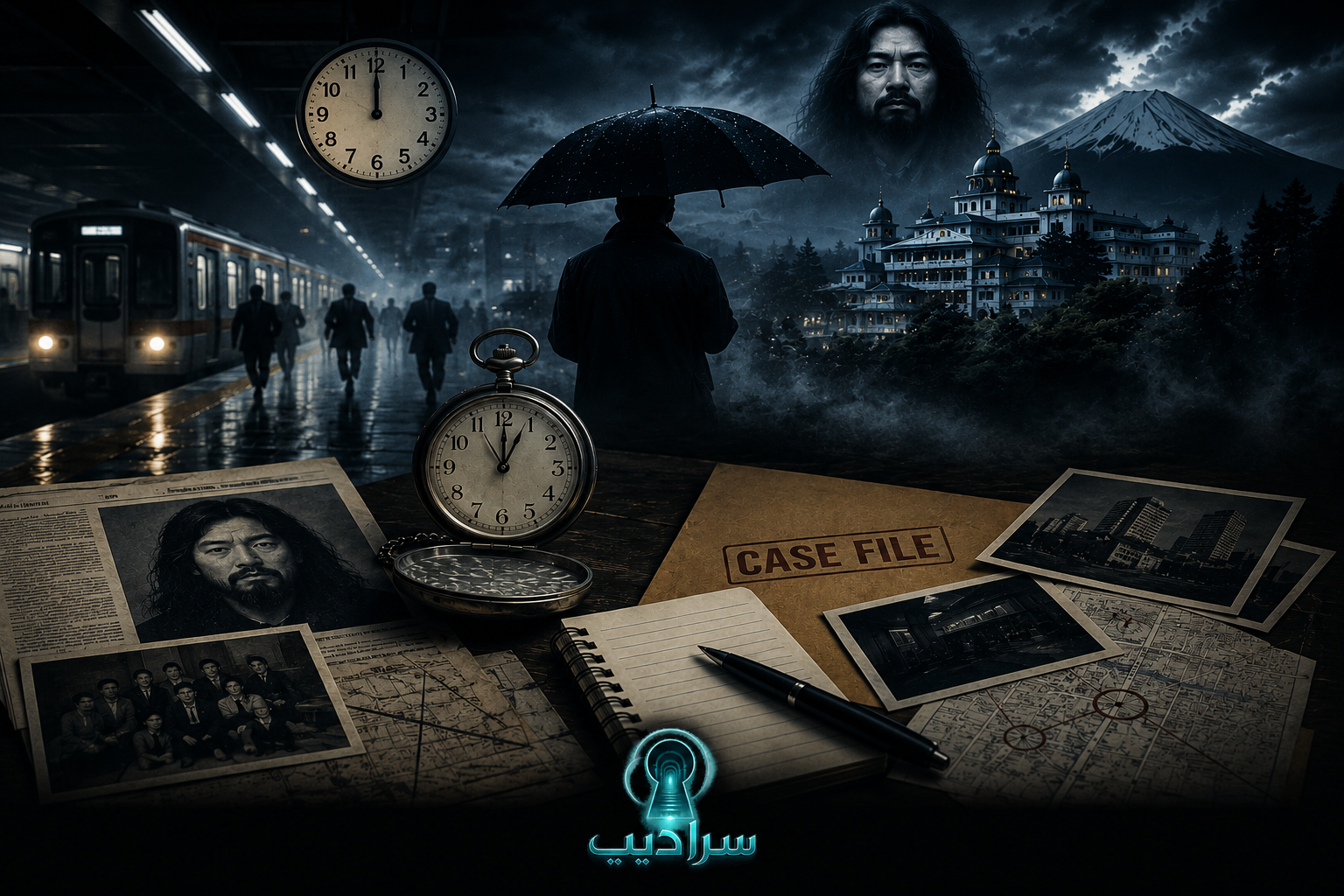
The police officers opened the door and found a spacious, windowless room. In the center sat a man on a wooden chair, wearing a black formal suit. His head was bowed forward, and his right hand was holding a pocket watch stopped at twelve-seventeen.
The man was dead.
They identified him quickly. His name was Fares Al-Meer, a wealthy businessman who had disappeared three days earlier, and the newspapers had been speculating about the possibility of him traveling abroad.
There were no signs of forced entry or struggle, and no obvious wounds appeared on his body. On the table in front of him was an old cassette tape and a short note:
“Everything began in 1980, and it will end in 2000.”
“Everything began in 1980, and it will end in 2000.”
Salim played the tape.
Fares's voice came out intermittently:
— There are four of us… we agreed that no one would talk. We took the money and left him to die. He told us he would return after twenty years, but we laughed at him.
Then another voice was heard in the background:
— You are left alone, Fares.
The recording ended with the sound of clock ticking.
The detective began reviewing the victim's past. He discovered that twenty years ago, Fares had been a partner to three men: Jamal Nasser, Adel Mansour, and Hatem Al-Deeb. The four founded a small company in 1980, which over the years turned into a commercial empire.
Strangely, the three partners had died in separate accidents during the final months of 1999.
Jamal drowned inside his car.
Adel fell from the roof of his house.
Hatem suffocated inside his office.
And all their watches had stopped at twelve-seventeen.
In an old archive, Salim found a news report about the disappearance of a young accountant named Marwan Sharaf in 1980. He had worked for the four men and accused them of stealing company funds. A few days later, he disappeared, and the case was closed due to lack of evidence.
The detective visited the home of Marwan's sister. She was an elderly woman named Laila, and when he showed her Fares's picture, her face changed.
She said:
— They killed my brother and buried him under the building they built with his money.
She meant the Station Street building.
Salim requested a search of the basement. After hours of digging, a skeleton was found inside an iron box. Beside it was a pocket watch stopped at twelve-seventeen.
But the analysis revealed something even stranger.
Marwan did not die in 1980.
The bones belonged to someone else.
The next morning, Salim summoned the building caretaker, Imad, for questioning. However, the caretaker had disappeared, and when they searched his files, they discovered that his real name was not Imad.
His name was Marwan Sharaf.
His picture was circulated throughout the city, but the police could not find him. In his small room, they found pictures of the four partners, maps of their homes, and numerous cassette tapes.
Everyone thought the case was closed, and that Marwan had returned to take revenge on those who tried to kill him twenty years ago.
But Salim remained unconvinced.
He returned to room 2000 and re-examined the chair and the table. He noticed that Fares's watch was not broken, but had been set manually. He also discovered that the recording was not made on the night of the crime, but years earlier.
Then he found a small inscription under the table:
S. R.
They were the initials of the detective himself: Salim Al-Rawi.
At that moment, the room's phone rang.
Salim picked up the receiver, and Marwan's voice came through calmly:
— I knew you would get here.
— Where are you?
— Very close.
— You killed them.
Marwan laughed and said:
— I only made them remember. It was fear that killed them.
Then he added:
— But Fares was not the last of them.
Salim felt a chill in his limbs.
The voice continued:
— Your father was the fifth man, wasn't he?
The connection was cut.
Salim froze in place. His father was the police officer who handled the investigation into Marwan's disappearance in 1980, then suddenly closed the case before buying a large house and retiring from service.
Two days later, Salim's father was found dead inside his home.
There were no signs of violence.
And in his hand was a pocket watch stopped at twelve-seventeen.
As for room 2000, it had completely disappeared.
And when engineers returned to the building's blueprints, they confirmed that there had never been any additional floor or secret corridor in that location.
But Salim kept one thing from that night.
A note he found in his father's pocket, which read:
“Some crimes do not end when the victims die, but when the last person who remembers the truth dies.”
“Some crimes do not end when the victims die, but when the last person who remembers the truth dies.”
Author: Munir
Have a thought or question about this article?
Continue the conversation in the community and share your ideas with readers and writers.

Comments 0
Share your thoughts respectfully. Abusive or disruptive comments may be hidden.